Is A Truck Mounted Drilling Rig Worth Buying?
Can a truck-mounted drill meet the construction needs of your project?
When your drilling project involves widely dispersed well locations that require frequent relocation, site roads that are accessible to vehicles, or situations where there is insufficient power supply or construction space—making it difficult to set up a fixed drilling rig—a truck-mounted drilling rig is the preferred choice.
Conversely, if well locations are concentrated, the construction cycle for each well is long, or site road conditions do not support the entry of wheeled equipment, tracked or fixed drilling rigs offer better value for money.
First, no crane is needed for scene changes.
This assessment is the key factor in equipment selection.
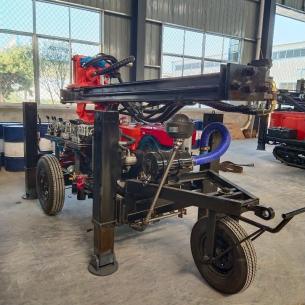
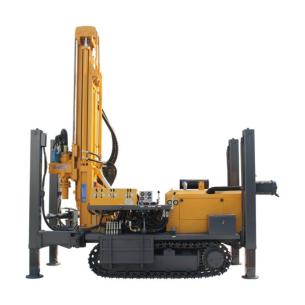
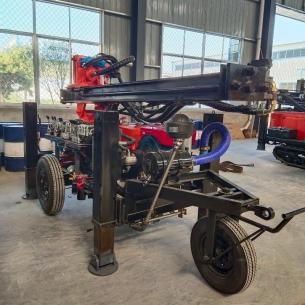
The truck-mounted drill rig integrates the entire drilling system—including the power unit, hydraulic system, drill mast, and control console—onto a truck chassis, eliminating the need for trailers or cranes and allowing it to travel directly on public roads. The drill mast can be folded down for transport as a single unit, making disassembly and reassembly hassle-free, and enabling quick mast erection and retraction.
Our Feida mobile drilling rig is equipped with an all-terrain off-road chassis, providing agile maneuverability. When used on Gobi Desert job sites, the time required for site relocation is reduced by more than 60 percent compared to traditional stationary drilling rigs. From a project perspective, the most tangible benefit is that in multi-well projects, the amount of downtime spent on relocation and setup is significantly reduced.
Second, the fully hydraulic power head features adjustable parameters
Most modern truck-mounted drilling rigs are equipped with fully hydraulic power heads, combined with load-sensing hydraulic systems, which provide ample torque and allow for flexible adjustment of rotational speed.
Another practical advantage of this hydraulic design is that the drill rig’s height can be adjusted using hydraulic cylinders, making it quick to adapt to different borehole diameters or construction methods.
Third, the chassis determines accessibility
A standard truck chassis is adequate for paved roads and typical off-road terrain; however, for locations such as deserts, wetlands, and the Gobi Desert, you’ll need to choose an all-terrain off-road chassis. Features like multi-axle steering and air-oil suspension aren’t just for show—if you don’t match the chassis class to the surface conditions at the project site when selecting a model, its “high mobility” will be significantly compromised in muddy or soft terrain.
Truck-Mounted Drilling Rigs vs. Crawler-Mounted Drilling Rigs
Comparison Criteria | Truck Mounted | Crawler Mounted |
Transportation Method | Self-propelled, traveling at highway speeds | Crawler-mounted; requires long-distance transport via flatbed truck |
Time Required for Site Relocation | Lowest; significant advantages for multi-well projects | Moderately high; includes loading and transportation |
Terrain Adaptability | Paved roads and off-road chassis adapt to the terrain | Better performance on soft ground, steep slopes, and rough roads |
Stability | Supported by outriggers; sufficient for conventional drilling | Stable chassis; suitable for extended periods of single-point operation |
Multi-well Cost-Effectiveness | Best; low proportion of non-drilling time | Moderate |
Typical Scenarios | Scattered well locations, water wells, geothermal sites, emergency response, and areas accessible by road | Mine benches, quarries, rugged terrain, and soft ground |
Description of Operating Conditions for Truck-Mounted Drilling Rigs
Mobile drilling rigs are not suitable for all drilling projects; choosing the right application is key to leveraging their advantages of quick relocation and rapid setup.
Projects particularly suited to vehicle-mounted drilling rigs:
1. Water wells and irrigation well clusters: Wells are scattered, and vehicles can access each well site directly;
2. Geothermal well construction: Particularly suitable for sites with limited space, such as within urban areas or near supporting facilities;
3. Mine emergency rescue boreholes: The key requirement is rapid deployment, positioning and commencement of drilling;
4. Coalbed methane and shallow oil and gas development: Continuous rolling operations across multiple well sites, with frequent changes of location;
5. Geological exploration and slope stabilisation works: Construction sites are dispersed, and individual boreholes are not very deep.
In the following scenarios, it is advisable to give careful consideration to the use of truck-mounted rigs and to prioritise the assessment of other rig types:
If well locations are highly concentrated and continuous drilling is required at a single site for several months, the cost advantages of skid-mounted rigs will be more pronounced;
Where the operational area consists of deep mudflats and steep slopes with no accessible roads, tracked rigs or helicopter-lift solutions would be a more reliable option;
For ultra-deep well projects where drilling depths are extremely high and the ground bearing capacity is insufficient to support the full weight of the rig, truck-mounted drilling rigs are also unsuitable.
The greatest value of truck-mounted drilling rigs lies in reducing the time required for relocation and setting up equipment. The more dispersed the project sites are and the more frequent the site moves, the better the cost-effectiveness of this solution.
FAQ
Can it be driven directly on public roads?
Vehicle-mounted drilling rigs are self-propelled units designed to be legally driven on public roads, and do not require a separate trailer when moving between sites. However, as vehicle certification and axle load regulations vary by region, these must be verified in advance; for heavy-duty models, a special road use permit may also be required in some areas.
What is the maximum drilling depth?
Standard water well models typically have a drilling depth of 300–600 metres; high-specification, fully hydraulic deep-well models can reach depths of up to 1,000 metres. However, depth is only a guide, as the borehole diameter and the selected drilling tool combination will both affect actual drilling capacity. We recommend that you provide the manufacturer with your specific site conditions to obtain tailored specifications.
Is it difficult to assemble, disassemble and commission a mobile drilling rig?
The entire rig is integrated onto a chassis, and the drill mast can be folded down for storage; once on site, the rig can be erected and positioned quickly, significantly reducing set-up time compared to skid-mounted drilling rigs.